Average Reviews:

(More customer reviews)Are you looking to buy The Swing Era: The Development of Jazz, 1930-1945 (History of Jazz)? Here is the right place to find the great deals. we can offer discounts of up to 90% on The Swing Era: The Development of Jazz, 1930-1945 (History of Jazz). Check out the link below:
>> Click Here to See Compare Prices and Get the Best Offers
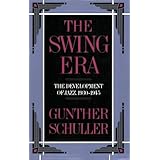
The Swing Era: The Development of Jazz, 1930-1945 (History of Jazz) ReviewTo get some idea of the achievement between these pages, just stop to think that Gunther Schuller listened to some 30,000 recordings, famous and obscure, from the period between 1930 and 1945, in chronological order for each band or performer. It took him fourteen years.Now you might think after all that that he would emerge with brain so fuzzy, ears so buzzed, that he could not write intelligently about the music, so submerged had he been for so long. But au contraire--this is the most lucid, the best anthology of any jazz era I've ever seen. No one could argue it isn't the most comprehensive. Schuller analyzes bands big and small, famous and unknown, national and "territory."
Some of his opinions go against the critically-accepted grain, which seems to have ruffled a few other reviewers here, but his point of the survey, I think, was to go beyong "lazy, complacent listening" and evaluate each work afresh. So we have a Count Basie orchestra that, while indisputably fine, isn't quite the jazz sin qua non that it's often held out to be. As Schuller points out--accurately, I think--Basie's band was a triumph because of the magnificent soloists, but frankly the arrangements were often uninspired and formulaic, the tunes undistinguished, the colors and contrasts minimized. This made me realize why I never liked other midwestern territory bands as much as the Count's: they generally didn't have the soloists, and without stellar soloists (and not just "good" soloists) it's hard to sustain interest in riffs and themes which quickly become routine. This may upset the apple cart with some people, but I think Schuller is on the money.
Similar, his assessment of Benny Goodman is generally spot-on, though I think I like some of the band's soloists more than he does and give them more credit than he does. However, he is mostly evaluating BG's studio recordings, and that band was far better live. (All bands are better in front of a live audience, of course, but the difference with BG's 30s group is truly stunning.) But Babe Russin was quite the fine understated tenor soloist, Chris Griffin was very underappreciated on trumpet (as was earlier Goodman trumpeter Nate Kazebier--hope I'm spelling that right). Jess Stacy is one of the unsung heroes of swing piano, especially as an accompanist (some of his best comping is on the 1938 Carnegie Hall Concert). Schuller basically ignores these sidemen. Even Ziggy Elman gets the short shrift, with a focus on his schlocky popular stuff instead of some of his logically-constructed solos. But I guess, even with 30,000 recordings under your belt, some performances are bound to escape your notice.
Schuller's chapter on Ellington could itself be a course at a university. You could indeed buy the book just for this section and play through all the recordings mentioned and come away far more knowledgeable about Duke, about jazz, and about music and composition in general. Discussing Schuller's take on Ellington is beyond the scope of this review, save to say it makes for pages and pages of fascinating reading.
Schuller also manages to cut through the Artie Shaw mystique (more BS than mystique, he feels; Shaw, with his verbal fecundity and limited knowledge of European art, was able to snow some jazz and pop writers, but he's just no match for Schuller). And he makes the interesting observation that Glenn Miller played far more true swing than he is credited for (though it was hardly innovative or even often very exciting swing) and Tommy Dorsey played far less, sticking with the Chicago/Dixieland two-beat style long after it had gone out of favor, until about 1940 (!). A lot of Dorsey's music is actually very hokey--"Mickey Mouse"--yet he is usually taken more seriously as a swing musician than Miller.
On the subject of smaller bands and lesser-known leaders from this period, Schuller points out how underappreciated Cab Calloway, Erskine Hawkins and Jimmy Lunceford were, and how relatively overrated Lionel Hampton, Bunny Berrigan and Louis Armstrong (of this period; the innovative Armstrong of the 20s was covered in his Early Jazz book) were. Again, these views--backed up by extremely thorough analysis and stoic discussion, will ruffle a lot of feathers among emotional keepers of the flame, but I find his analysis to be rather spot-on. Also invaluable is his clear-headed discussion of Art Tatum's strengths and weaknesses.
The book is chock full of examples in music notation, and in some instances whole solos and passages are written out. That may scare off some who cannot read music, but it shouldn't. It will largely help to have the recordings in the CD player, ready to go, so the reader can follow along with the notation. And everyone will not follow every discussion of harmonies, scales and chord progressions--no matter. You don't have to understand everything to get a lot from this work, and repeated readings will benefit you as well. Just don't show it to anyone to whom jazz is a religion, and its players are holy priests; they won't appreciate some of Schuller's deconstructions.
Incidentally, Schuller is supposedly working on a volume III that deals with the bebop era and the development of "modern" jazz. (The first volume of this series dealt with pre-1930s jazz and is also a classic.) Considering how much time the present book required, I hope he lives long enough to finish this magnificent project.The Swing Era: The Development of Jazz, 1930-1945 (History of Jazz) Overview
Want to learn more information about The Swing Era: The Development of Jazz, 1930-1945 (History of Jazz)?
>> Click Here to See All Customer Reviews & Ratings Now

0 comments:
Post a Comment