Average Reviews:

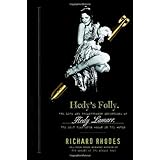
(More customer reviews)Are you looking to buy Hedy's Folly: The Life and Breakthrough Inventions of Hedy Lamarr, the Most Beautiful Woman in the World? Here is the right place to find the great deals. we can offer discounts of up to 90% on Hedy's Folly: The Life and Breakthrough Inventions of Hedy Lamarr, the Most Beautiful Woman in the World. Check out the link below:
>> Click Here to See Compare Prices and Get the Best Offers
Hedy's Folly: The Life and Breakthrough Inventions of Hedy Lamarr, the Most Beautiful Woman in the World ReviewHedy Lamarr was a Hollywood star, considered one of the most beautiful women in the world. She was also an inventor. These two disparate sounding facts would make anyone sit up and take notice. We are fortunate that a writer of the caliber of Richard Rhodes did notice. What he gives us is a fascinating account of Lamarr and her fellow inventor, musician George Antheil, as well as a host of other topics including evocative portraits of 1920s Vienna and Paris, insightful commentary on Hollywood and World War 2 and a crystal clear account of the technical details behind Lamarr and Antheil's key invention- spread-spectrum frequency hopping, a technique which can be used for jam-proof wireless communication in everything from submarine transmission to cell phones.As is the case with his other commanding works, Rhodes is most adept at creating sharp character portraits of the main protagonists and an evocative recreation of the times that they lived in. He also offers a characteristically lucid account of science and technology reminiscent of the accounts in his landmark "The Making of the Atomic Bomb". Wherever possible he lets the characters speak in their own voices. He starts by describing Hedy's childhood in 1920s Vienna, a city that was a mecca for the arts and a sort of dream world for the young and ambitious. Acting was in Hedy's blood and with the encouragement of a doting father, she never looked back. After starring in a variety of roles, some scandalous for the times, she had the misfortune to marry a charming but opportunistic arms dealer who was cozy with fascists and Nazis and who turned Hedy into a trophy wife trapped in a golden cage. Endowed with an exceptionally keen mind and remarkable powers of observation, she soaked up discussions of weapons systems and armaments while attending lavish parties thrown by her husband. Even as she was expected to sit still and smile, she would carefully listen to descriptions of advances in military hardware from experts like the rocket and submarine pioneer Hellmuth Walter.
Tired of the growing brutality in Germany and trapped in an unhappy marriage, Lamarr fled to Paris, London and then to the United States where she was swept up right away by a Hollywood which was then eagerly showcasing immigrant European actors. Lamarr acted in a string of successful Hollywood movies and became known for her beauty, but the most consequential event in her life was her meeting with her California neighbor George Antheil, an avant garde musician who had spent the 1920s socializing with American expatriates in Paris and musicians like Igor Stravinsky. Like Lamarr, Antheil had an exceptional technical bent which he exploited in arranging complex combinations of player pianos and other musical instruments - an early analog version of orchestration and automated control. His "Ballet Mécanique" featuring a joyous panoply of diverse instruments and sounds had been a sensation in Paris. Apparently Lamarr first met Antheil for advice on breast augmentation since Antheil had written a few articles on the topic. But when she learnt about his background and mechanical inclination, the two struck up a close professional relationship and friendship (although Antheil was married and Rhodes find it very unlikely that they were intimate). Distressed partly by the sinking of passenger ships by German submarines and wanting to use her secretly gained knowledge of weapons systems, Lamarr had an idea for transmitting radio signals to torpedoes to guide them to their target.
In those days, wireless transmission was risky since it was based on a single frequency which the enemy could intercept. Based on her understanding of these limitations gathered from listening on conversations that her ex-husband had had with military personnel, Lamarr came up with an idea for rapidly switching transmission and reception between various frequencies, thus thwarting easy attempts at detection. Knowing about Antheil's technical bent, she took the idea to him and together they filed a key patent laying out the features of the idea in 1942. While early incarnations of the invention involved manually switching the frequency, the design soon metamorphosed into one using piano rolls (with which Antheil was intimately familiar) to semi-automatically hop between different frequencies. An ingenious addition was the inclusion of three empty channels for broadcasting "dummy" frequencies devoid of information to further confuse the enemy's jamming attempts. After final refinements, Antheil and Lamarr made a presentation to the U.S. Navy which failed to take them seriously, partly because they found it hard to believe that a Hollywood actress and an avant garde musician could come up with such a novel idea. As usual, Rhodes is excellent when explaining the scientific background of radio communication and the novelty of the Lamarr-Antheil model.
The innovative and strategically key invention languished in the shadows until it was discovered out of necessity by the Navy which was looking for a way to enable jam-proof communication between ships and aircraft. It started to be implemented in a variety of important devices and systems and was used in the Bay of Pigs invasion. Today its remnants are used in a wide variety of communications technologies, from cell phone networks to sophisticated radar systems to GPS. In 1997 the Electronic Frontier Foundation gave Lamarr an award for her work. Hedy herself withdrew from public life and died in 2000; Antheil had sadly died long before in 1959 without being recognized for his contributions.
Perhaps the most revealing and saddening part of Rhodes's story is its description of how people failed to take Lamarr seriously as an inventor because she was a beautiful woman and a Hollywood actress. Lamarr herself used to say that her beauty was a curse, blinding people to any other talent she might have. In fact she was unlike most celebrities, eschewing parties and drinks and preferring quiet evenings filled with interesting conversations. Sadly, stereotypical views endure and beauty continues to be often regarded as incompatible with scientific or intellectual talents, especially among women. In a society that can value looks above everything else, Lamarr's story is a resounding counterexample and a role model for young girls that should help shatter stereotypes and reinforce the notion that disparate talents can manifest themselves in the same individual. Rhodes has picked an exceptionally interesting character to showcase this fact and he tells her story with verve, sympathy and clarity.Hedy's Folly: The Life and Breakthrough Inventions of Hedy Lamarr, the Most Beautiful Woman in the World Overview
Want to learn more information about Hedy's Folly: The Life and Breakthrough Inventions of Hedy Lamarr, the Most Beautiful Woman in the World?
>> Click Here to See All Customer Reviews & Ratings Now

0 comments:
Post a Comment