Average Reviews:

(More customer reviews)Are you looking to buy Guide to the Pianist's Repertoire, third edition? Here is the right place to find the great deals. we can offer discounts of up to 90% on Guide to the Pianist's Repertoire, third edition. Check out the link below:
>> Click Here to See Compare Prices and Get the Best Offers
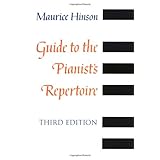
Guide to the Pianist's Repertoire, third edition Review"Essential," "Indispensable," "Invaluable," "Crucial." Those are a few of the labels often applied to this remarkable book. Currently in its third edition, Maurice Hinson's "Guide to the Pianist's Repertoire" is still the most sought-after reference for essentially all solo piano music of significance. Outside professional private instruction and a reliable piano technician, every serious piano student needs three tools on hand: a piano, piano music, and this guide. Hinson's reputation as both an effective and productive musicologist is firmly established in this work.The book is structured into two primary sections. The main section, Part 1, is alphabetically categorized by composer. Each referenced work includes a list of available publications, their editors, and the composition's date if known. Hinson includes a brief yet vivid description of the style or character of a given piece and, in most cases, a comment or two on some of the technical requirements one can expect for preparatory purposes. The guide is also a reliable reference to books for further study of a given work. Both logic and common sense went into organizing the massive collection of data. The guide also proves sensibly formatted for sections of large volume by a single composer, such as the collections of Bach or Chopin, for example.
Part 2 is an impressive reference to published anthologies, subdivided into four categories. The first category, "General," lists publications of character pieces, impressionistic works, and any number of "Heinz 57" types. There is a "General: Contemporary" section for twentieth century collections. In addition to Bartók, Prokofieff, and others from the earlier years of the century, one can also find reference to works by Boulez, Kohlenz and Harbison, to name a few. The third category, coined "Tombeaux, Hommages," is a brief list of collections of works composed in honor of another composer. The fourth category, the largest of the four, is a comprehensive reference to piano collections by nationality. It is subdivided alphabetically.
The book includes an appendix of historical recital programs by Rubinstein, Busoni and Gabrilowitsch. There is also an impressive group of indexes for referencing under different category types.
The entire collection of works are broadly lumped into four technical grades. The labels are "Easy," "Intermediate (Int.)," "Moderately Difficult (M-D)," and "Difficult (D)." It may help the amateur, when focusing on technical problems, to limit the comparisons to other works of the same genre or by the same composer, rather than cross-comparing any two works that happen to have the same grade.
For example, Franz Liszt's "Transcendental Etudes" is marked "D" for difficult; likewise György Ligeti's "Etudes for Piano" is graded "D." Since the primary technical demands for these two works are as different from each other as the works themselves, the grade is really little more than a signal that both works will require extensive work and patience beyond most anything marked M-D. Naturally, the serious piano student will pursue further research for works of this magnitude anyway, but Hinson's commentary often provides key information for what lies ahead. In Liszt's etude collection, for instance, the player will confront "double-note tremolos," and a "melody with rapid tremolo accompaniment in the same hand." For Ligeti's set, the performer faces "polyrhythmic, simultaneous progressive layers of tempo" and a command in dynamics ranging between ffffffff and pppppppp. Hinson's carefully worded descriptions often prove crucial in matters such as this. It pays to note them.
This massive project is both focused and thorough. Hinson has delivered a beneficial service for the serious piano explorer. Even casual browsing proves enlightening.
One request for the next edition: since the "Tombeaux, Hommages" category is so small, and only a few homages happen to be in collections, perhaps a comprehensive list of all published piano homages would make a worthy addition. Sincere thanks from this aging amateur pianist and music-lover goes to Mr. Hinson, the publisher, and to all teachers and professionals involved in the making of this excellent handbook.Guide to the Pianist's Repertoire, third edition Overview
Want to learn more information about Guide to the Pianist's Repertoire, third edition?
>> Click Here to See All Customer Reviews & Ratings Now

0 comments:
Post a Comment